A PM plan for companies servicing restaurant kitchens in the UAE: the rules that apply, what the outlet does daily, what your technician checks, and proof.
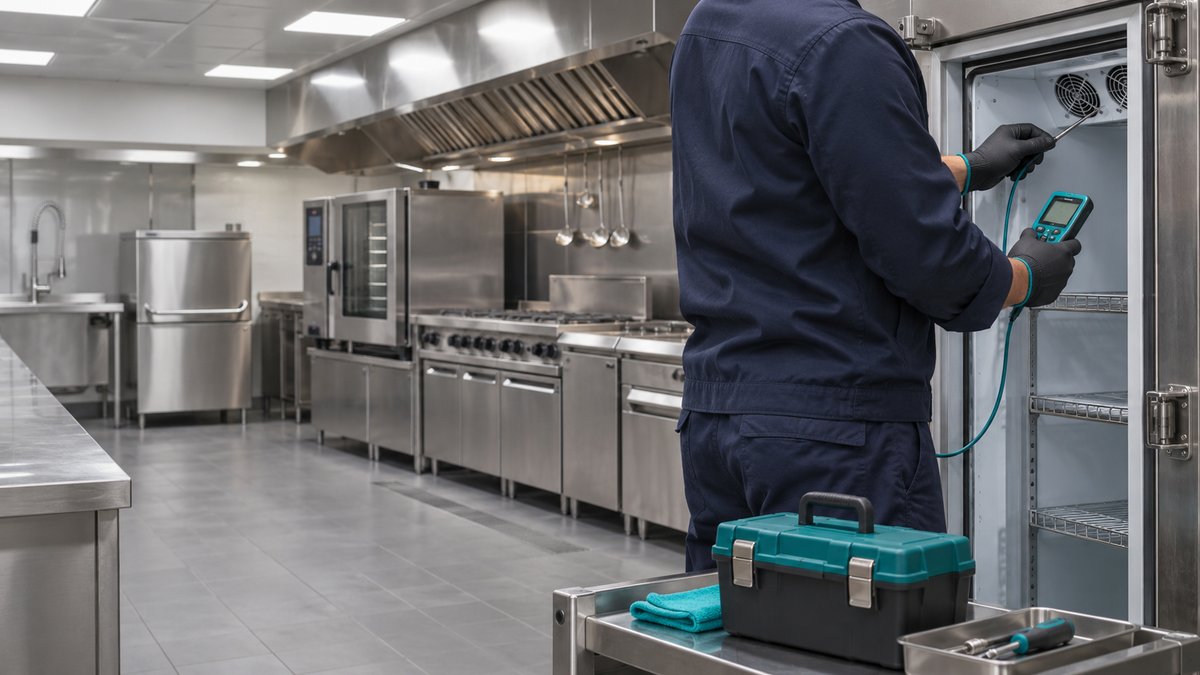
Table Of Content
A commercial kitchen PM schedule splits the work in two. The outlet's own staff handle daily and weekly cleaning, and your technicians handle planned visits to refrigeration, cooking lines, dishwashers, ice machines and extraction. In the UAE, some of that work, like fire suppression and central gas, may only be done by an approved company.
Drafted with AI. Reviewed by Fayis K.
Key takeaways
Four sets of rules shape a kitchen AMC in the UAE: federal Civil Defence rules for fire safety systems, emirate rules for gas, Dubai Municipality's kitchen safety guideline, and the federal rules on refrigerant gases. Check which apply to each outlet before you price the contract.
Fire safety systems, federal. Cabinet Resolution No. 24 of 2012 on Civil Defence services requires owners of establishments and buildings to carry out periodic maintenance of preventive safety systems. For a restaurant, the kitchen hood fire suppression system is part of this. In Abu Dhabi, the Civil Defence Authority has said the absence of a valid, Civil Defence approved maintenance contract for fire alarm and firefighting systems carries a Dh10,000 fine, and Gulf News has reported the authority warning that maintaining fire safety systems without its approval can bring a Dh50,000 fine.
What this means for you: if your company is not Civil Defence approved, keep kitchen suppression systems out of your scope and say so in the AMC.
Gas, Abu Dhabi. Abu Dhabi's Gas Safety Committee, working with the Civil Defence Authority, inspects gas and fire detection systems in food establishments. It requires gas detectors and gas systems to be installed by approved companies, and expects facilities to keep a regular maintenance contract with an accredited company.
Kitchen safety, Dubai. Dubai Municipality's technical guideline for occupational health and safety in kitchens (Technical Guideline 46, version 3, 2024) sets several checks that fit straight into a PM plan:
| Item | What the guideline says |
|---|---|
| Hood filters | Remove and clean at least once a week |
| Cooker surfaces and hoods | Clean daily |
| Ducting and fan blades | Clean the inside surfaces, with the fan locked off |
| Electrical equipment | Check its condition annually |
| Steam boilers | Tested and certified by a licensed competent person every 12 months |
| Deep fat fryers | Check temperature controls periodically |
| Cold stores | Door opening mechanism in good working order; a warning signal for anyone locked in |
| Gas | An emergency shut off valve in the kitchen where gas comes through a manifold |
Refrigerant gases, federal. Ministerial Decree No. 138 of 2023 from the Ministry of Climate Change and Environment regulates HFC refrigerants. Establishments handling HFCs must register with the ministry, report quantities quarterly and avoid releasing HFCs into the atmosphere. If your technicians recharge or recover refrigerant on cold rooms and fridges, check what the decree asks of your company.
The outlet does the daily and weekly cleaning, and the contractor does the planned technical checks. Writing this split into the AMC stops the most common argument in kitchen maintenance: a failure that both sides thought the other was watching.
| Done by | Typical tasks |
|---|---|
| Outlet staff | Daily hood and cooker cleaning, weekly filter cleaning (as the Dubai guideline sets), fridge and freezer temperature logs |
| Your technician, each PM visit | Refrigeration, burners and gas connections, electrical condition, door seals, controls and safety cut outs |
| An approved or licensed company | Fire suppression service, central gas maintenance, steam boiler certification, grease trap emptying |
Ask for a photo of the outlet's temperature log at each visit. Dubai Municipality expects cold food to be kept below 5°C, so a cold room drifting upwards shows in the log before it fails.
Each visit should follow a fixed checklist per equipment type, so any technician can do it and the report reads the same every time. The table is a starting plan: set the final intervals from each manufacturer's manual and the AMC.
| Equipment | Every PM visit | Deeper visit (example: quarterly) |
|---|---|---|
| Walk in cold rooms and reach in fridges | Temperatures against setpoint, door seals, door release and alarm, drain lines | Clean condenser coils, check refrigerant pressures, defrost cycle, fan motors |
| Ice machines | Water filter, bin and chute hygiene, ice quality | Descale and sanitise per the manual, inlet valve and pump |
| Combi and convection ovens | Door seals, fans, temperature accuracy, error log | Descale steam generator, probes and controls |
| Fryers | Thermostat accuracy, high limit safety, gas connections or elements | Burner or element inspection, drain valve |
| Dishwashers | Wash and rinse temperatures, chemical dosing, spray arms | Descale, heating elements, pumps and seals |
| Gas ranges and burners | Flame quality, ignition, hose condition, kitchen shut off valve | Full gas safety check by a qualified technician |
| Hood and extraction | Filters in place and being cleaned weekly, fan running | Grease inspection on the schedule below |
There is no UAE specific interval we could find in an official source, so most contractors use NFPA 96, the international fire standard for commercial cooking ventilation. Its Table 12.4 sets grease inspection by cooking type:
| Type of cooking | Grease inspection |
|---|---|
| Solid fuel (charcoal, wood) | Monthly |
| High volume (24 hour cooking, charbroiling, wok) | Quarterly |
| Moderate volume | Twice a year |
| Low volume (seasonal businesses, places of worship) | Once a year |
When an inspection finds grease build up, the system is cleaned. Confirm with the emirate's Civil Defence what it accepts for the outlets you cover.
In Dubai, grease traps must be cleaned by a company Dubai Municipality has permitted, with the waste taken to the municipality's recycling plant, according to its grease trap guideline. If your company does not hold that permit, keep grease traps out of your scope in writing.
Plan by area and visit type, not by contract. A technician who covers several outlets in one mall or district in a morning completes far more visits than one who crosses the city for each contract.
Proof is a completed checklist, photos and a signed report the client can open the same day. Kitchen managers rarely sit at a desk, so the report has to reach their phone.
With Zentid, the technician fills the checklist and uploads photos through WhatsApp prompts, logs parts used (including by photographing a barcode), and the outlet manager signs through a link on WhatsApp. The service report is ready in English or Arabic when the job closes. For basements and plant rooms with no signal, the Zentid Field app works offline and syncs later.
For planning, Zentid's PPM agent, which is live with customers, prepares the planned visits from your contracts and assets, and a person approves the schedule before it goes out.
If you run kitchen equipment AMCs across many outlets, the quickest test is one week of PM visits planned and reported in Zentid. Book a demo and bring two or three of your real contracts.
Drafted with AI. Reviewed by Fayis K.
FAQ
It depends on the equipment, the manufacturer's manual and how hard the kitchen is used. Most contractors agree a regular PM visit per outlet plus a deeper visit, and write the intervals into the AMC.
No. Under Cabinet Resolution No. 24 of 2012, fire safety systems are maintained through companies approved by Civil Defence. A contractor without that approval should leave suppression systems out of its scope.
Dubai Municipality's kitchen safety guideline says filters should be removed and cleaned at least once a week. Hood and cooker surfaces are cleaned daily.
A company permitted by Dubai Municipality, which takes the waste to the municipality's recycling plant.
With a completed checklist, before and after photos, and a report signed by the outlet manager, sent the same day so the client sees it without logging in anywhere.
Everything you need to know about Zentid. Can't find the answer you're looking for? Feel free to contact us
Explore industry trends and valuable insights to keep you informed and stay ahead of the competition.




 Inventory
 Assets
 Contracts
 Projects
 Fleet
 Service Portal
 FieldFinance
 HR & Culture
 WhatsApp FSM
 Employee/Technician Tracking
 GPS Attendance
 Work Order Management
 Quotations
 Service Dispatch
 Overtime tracking software